
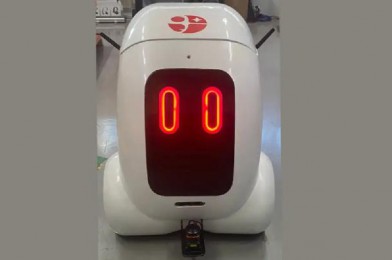
BRIN Autonomous Delivery Robot Operates In Lab - Security Guard Post
To ensure security, the BRIN DELL-E autonomous goods delivery robot is equipped with a QR Code-based authentication system.
The National Research and Innovation Agency (BRIN) has developed DELL-E (Delivery Enhanced for Logistics & Last-mile Express), an autonomous delivery robot designed to support services in environments with limited access (restricted areas). These environments include gated residential complexes, apartments, office buildings, campuses, industrial zones, and government facilities, which often face challenges in the delivery process.
“In such environments, couriers are generally only allowed to deliver items up to security posts or designated handover points, requiring recipients to collect their packages independently. This condition is considered inefficient, especially in large areas with complex internal mobility,” said Roni Permana Saputra, a Researcher at BRIN’s Intelligent Mechatronics Research Center, in a written statement on Wednesday, February 4, 2026.
He explained that DELL-E was developed to improve logistics service efficiency, reduce human workload, maintain consistent delivery times, and minimize the risk of errors and direct contact in goods distribution within controlled environments. In its development, he added, DELL-E is equipped with a multi-sensor navigation system that combines LiDAR, IMU, and GPS.
“The integration of these sensors allows the robot to perform area mapping, route planning, and autonomous movement under various environmental conditions,” he said. The robot is also connected to a server-based application that enables users to place orders and monitor delivery status in real time, as long as an internet connection is available.
To ensure security, DELL-E is equipped with a QR code–based authentication system. This mechanism ensures that only authorized recipients can open the compartment and retrieve the goods.
Roni explained that DELL-E’s operational process begins with ordering through the application, determining the destination location, automatic route planning, and autonomous delivery of goods. During its journey, the robot is designed to detect and avoid obstacles to ensure operational safety.

According to him, initial trials of DELL-E have been conducted at the Samaun Samadikun Science and Technology Area in Bandung, with a delivery scenario from the autonomous laboratory to a security post. The test results, Roni said, showed fairly good performance in following routes and avoiding obstacles, although further refinement is still needed to improve system reliability.
“As a robotics innovation developed domestically, DELL-E is expected to strengthen national technological independence in the field of intelligent logistics,” he said. In the future, DELL-E could become part of the smart city ecosystem, supporting efficient, safe, and sustainable autonomous logistics services, while also encouraging the adoption of service robot technology in Indonesia.